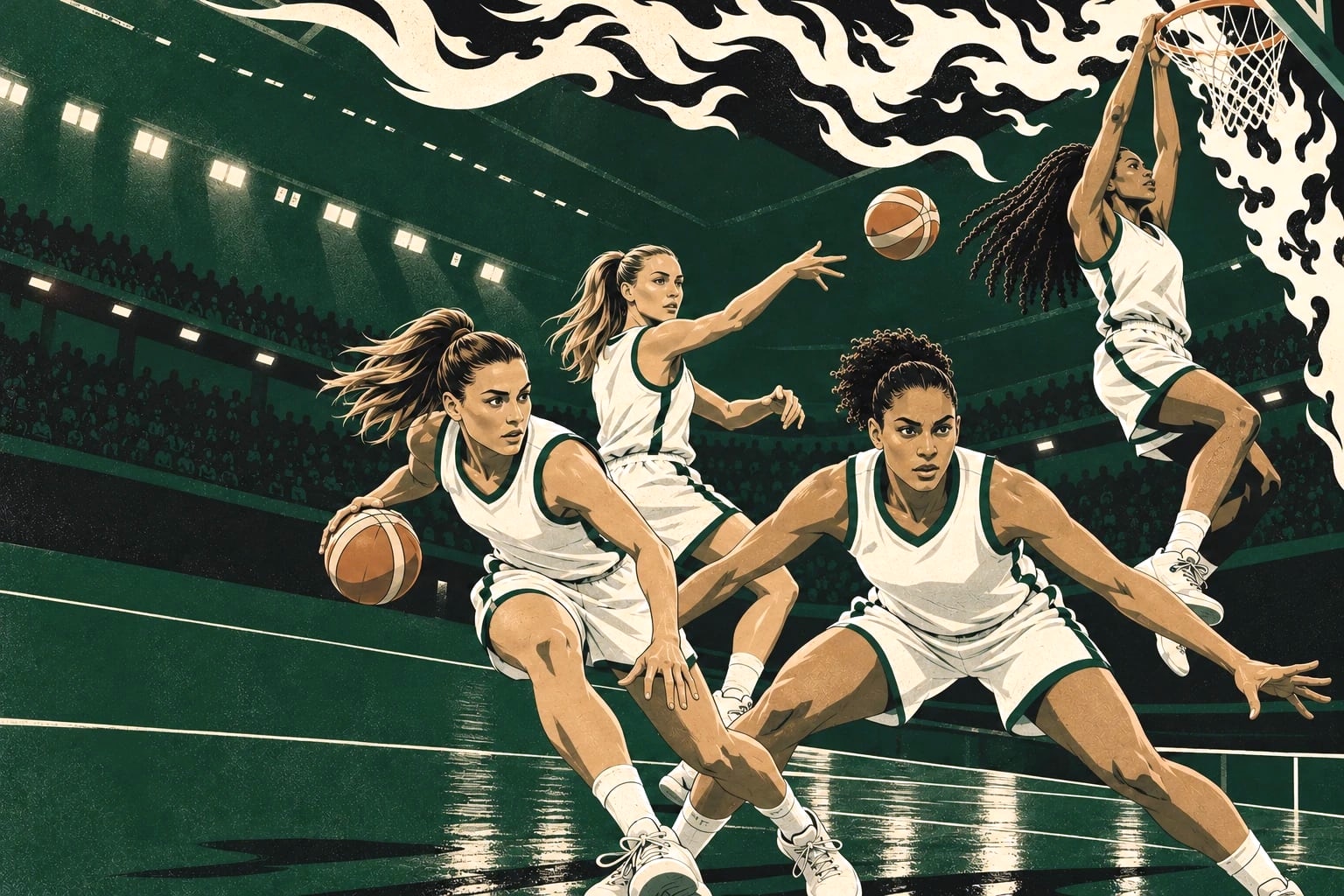
"I hope the French are proud." Yes, Gabby, we are!
On 31 October, Gabby Williams walked into her press conference minutes after being named WNBA Finals MVP, an honour only Tony Parker had won before her in the history of French basketball. The Golden State Valkyries, her franchise, created just two years ago, had just won the title in the deciding game against Atlanta, led by their French forward, who scored 28 points in the second half.
Her first thought was for Les Bleues: "I wouldn't be here without the French national team." It was no empty line. In 2021, she accepted a season-long suspension from the Chicago Sky, who refused to let her miss part of the season to play at the EuroBasket and the Tokyo Olympics with France. The former high-jump prodigy (the youngest athlete entered at the 2012 US Olympic Trials), whom we had last seen devastated after the World Cup final lost to the Americans, of all teams, has closed out a historic season, one that will go down in basketball history, men's and women's game alike.
And then there's the context: the kind of pressure only the American media know how to cook up. On the eve of Game 1, ESPN published its ranking of the top 15 players in the Finals. Gabby Williams was second, behind Angel Reese, Atlanta's young star and the Defensive Player of the Year (again ahead of Gabby Williams). Williams's reply was short and to the point: "The media has never respected me. I've never expected them to."
The start of the series seemed to prove ESPN right. In Game 2, Reese put up 30 points and 16 rebounds, while Williams went 3 of 15 from the field, visibly rattled by the occasion. In the next game, Atlanta beat the Valkyries again, and Reese made her "too small" gesture at the Golden State players.
A pointless provocation. The Valkyries won Games 4 and 5, and Reese changed her tune, complaining about the officiating in her press conference ("Gabby pulled me on purpose, and they didn't call it"). The Dream then won Game 6, and Gabby Williams, asked about the early tip-off, refused to look for any excuse: "They played at the same time as us, right?" Which brought us to the historic Game 7 on 31 October. Without a true superstar, the Valkyries showed that with a tight-knit group and an iron defence, nothing is impossible.
So in 2026, Gabby Williams won (almost) everything: the EuroLeague with Fenerbahçe in the spring, the WNBA title with the Valkyries in the autumn, and in between, a silver medal at the World Cup with France. It was made possible by the WNBA calendar, which runs from May to October and leaves players the winter for European competitions. Roughly speaking, it's like winning the Champions League and the Copa Libertadores in the same year, and playing in a World Cup final on top of that.
And Gabby Williams isn't the only Frenchwoman making waves across the Atlantic. First, there's the alien, Dominique Malonga. Twenty years old, 6ft 6in, taken second overall by Seattle in the 2025 draft: this summer, in only her second season, Malonga was picked for the All-Star Game, where she became the youngest player in history to dunk, a move that is still rare in the women's game.
Then there's MJ23, Marine Johannès, who needs no introduction. At 31, she is still one of the most spectacular (and inconsistent?) players in the world. A monster when she's confident, Johannès remains one of France's spearheads.
Janelle Salaün, Williams's teammate at the Valkyries, can guard both guards and bigs. Iliana Rupert, another of France's frontcourt players, also wore a Valkyries jersey in the franchise's first season. At point guard, Pauline Astier, 24, made her WNBA debut this year and was named to the All-Rookie Team, a year after Leïla Lacan, the Connecticut Sun point guard born in Rodez, who was among the best rookies of the 2025 season.
It's a talent pool French basketball has never had before, one we can be proud of, and one that makes The Take believe these players are worth their weight in gold. Two years ago, France lost the Olympic final by a single point. Next stop: Los Angeles, 2028, to silence Angel Reese once again and win the only colour of medal this generation is still missing.