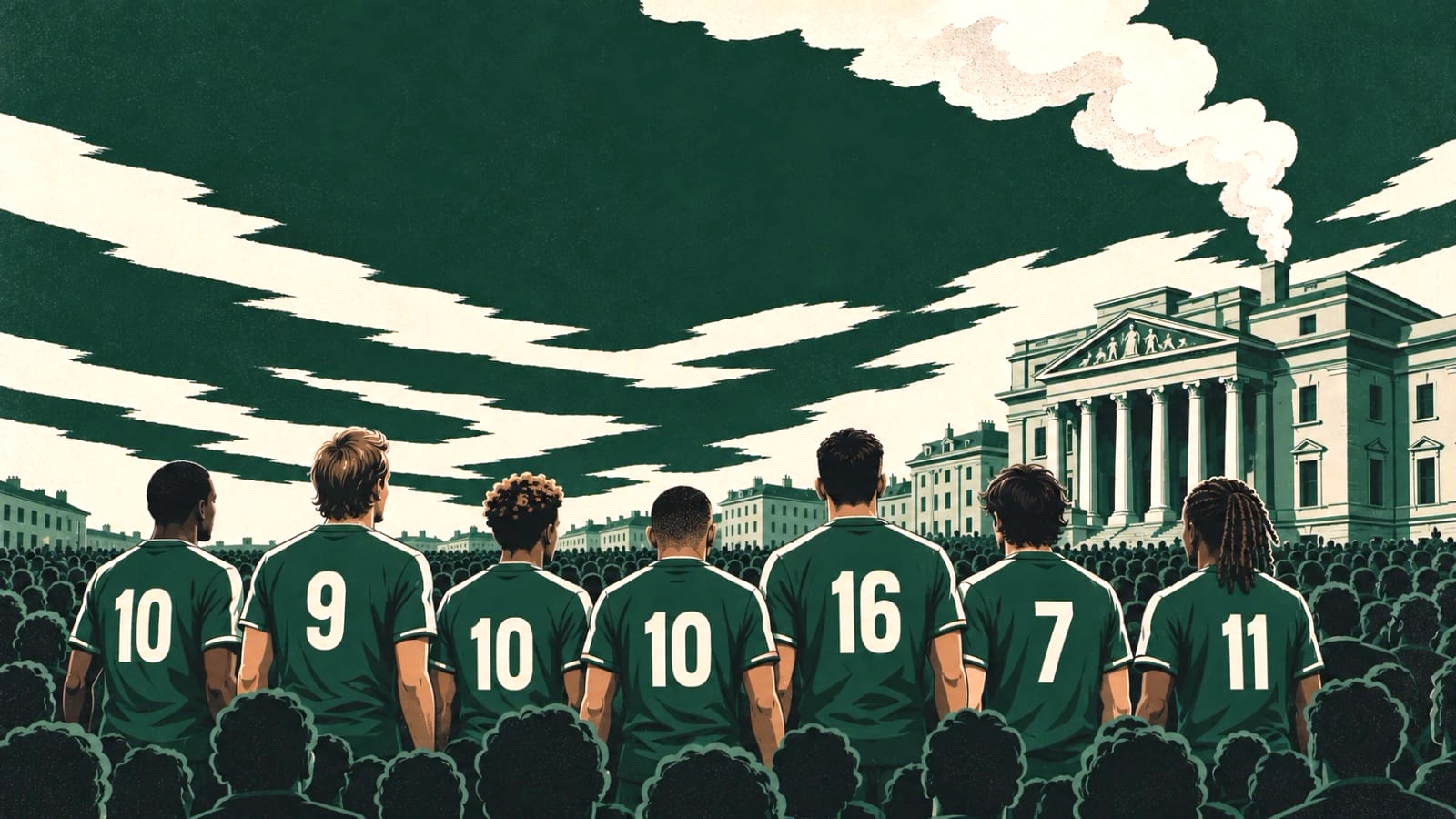
The 2026 Ballon d'Or, handed out in London this year (a happy coincidence), was the most uncertain in years, and it's fair to say the result announced on 26 October hasn't really settled the argument surrounding its attribution.
Harry Kane won, ahead of Kylian Mbappé and Lamine Yamal. He is the first Englishman to win since Michael Owen in 2001, and the first winner since Lionel Messi in 2019 without a Champions League or a major international tournament to his name. Leave aside the two freaks of nature, Cristiano and Messi, and you have to go back to Ronaldinho in 2005 (the year of Liverpool's surprise Champions League win in Istanbul).
Don't get me wrong: Kane had a record-breaking season, that's beyond dispute. The rules ask the hundred jurors designated by France Football to judge the season on three criteria: individual performance and how decisive a player was, then team honours, and finally a rather subjective one: class and fair play. What they don't say is how to weigh them...
Kane won the Bundesliga and the German Cup, but is that really an achievement? And how do you ignore a World Cup at which Kane was only the second or third best player in his own team?
When none of the criteria point to a winner, the logical thing, for us, is to go back to the simplest question of all: who is the best player in the world right now? For us, the answer to that question is Lamine Yamal.
This is the ballot we would have handed in if The Take had a vote.
1. Lamine Yamal (Barcelona, Spain)
3rd in the official ranking
The best player in the world, full stop. La Liga's player of the season for the second year running, a league champion with Barça and the scorer of 24 goals in all competitions, Yamal missed the end of the season through injury, including the Clásico that won Barcelona the title. He made it back (just about) in time to win the World Cup with Spain at nineteen, playing in every game that mattered. We would have liked to see him make more of a difference at the tournament, but it's also fair to say that no player gets more attention from opposition defences. Nobody else combined a league title, a world title and that much influence on how both his teams played over the same period.
2. Ousmane Dembélé (PSG, France)
7th in the official ranking
He was supposed to be burnt out, unable to repeat his Ballon d'Or season, but Ousmane Dembélé proved his critics wrong. Despite injuries that cost him part of the season, he was magnificent and decisive in the Champions League knockouts: two goals at Anfield in the quarter-final, two more in the 5-4 win over Bayern in the first leg of the semi, a goal inside three minutes of the second leg in Munich, then the equalising penalty in the final against Arsenal, before PSG won the shootout. He also clearly took a step forward with France at the World Cup, even if he is still some way short of the level he reaches with Paris. It's enough, though, to put him ahead of Kvara, third on our list.
3. Khvicha Kvaratskhelia (PSG, Georgia)
6th in the official ranking
Along with Messi and Fabián Ruiz, the hardest player to place. UEFA named him the Champions League player of the season, and his spring more than holds up next to Dembélé's: two goals in the 5-4 against Bayern, the assist for the opener in the second leg, then the penalty he won in the final. Without a World Cup this year, he would have been the Ballon d'Or winner, no question. But there was a World Cup, and Georgia weren't at it (Spain and Turkey finished ahead of them in qualifying). Kvara also pays for the debate inside PSG about him and Dembélé, which not even the club managed to settle. His patchy form in Ligue 1 doesn't help either.
4. Michael Olise (Bayern Munich, France)
9th in the official ranking
A season in capital letters, and an official ranking that is a lack of respect in capital letters too. Olise was the Bundesliga's top provider, with thirty-four goals and assists in the league, and it was him, not Kane, whom the Bundesliga named player of the season. He finished joint top assister in the Champions League with eight, then set up seven goals at the World Cup, a single-tournament record that had belonged to Pelé since 1970. Finally at home in a France shirt, he may be paying for not officially being the main man for either club or country. For us, he was one of the three most enjoyable players to watch this season.
5. Kylian Mbappé (Real Madrid, France)
2nd in the official ranking
To conquer without peril is to triumph without glory. Fifty goals, the Pichichi in La Liga, top scorer in the Champions League, the World Cup Golden Boot with ten goals, and the all-time scoring record at the tournament with twenty-two: Mbappé won everything this year except a game that mattered. Real Madrid finished second in La Liga and went out of the Champions League in the quarter-finals, and France lost their World Cup semi-final. He is already a legend, but the bar we set for him matches the one he sets for himself. Ranking him any higher would do a disservice to the player he could be, and should be. He is, after all, the Chosen One.
6. Harry Kane (Bayern Munich, England)
Ballon d'Or winner
For a long time, it felt as if he never got the credit he deserved. Beyond the ridiculous numbers, Kane has had the kind of positive effect on how his teams play that we had rarely seen from a number 9 since a certain Karim Benzema. The jury finally looked past the stubborn image of the charisma-free nearly man that followed him from Tottenham to England, and you can't blame them for rewarding a season like this one. But in the two games that could have defined it, the Champions League semi-final against PSG and the World Cup semi-final, his team went out, and Kane was largely anonymous.
7. Lionel Messi (Inter Miami, Argentina)
5th in the official ranking
We've never seen anything like it: the GOAT, plain and simple. Yes, he plays in MLS, and he probably had more time than most to get ready for the summer. But images matter, and what Lionel Messi produced at thirty-nine, at his sixth World Cup, earns him a place in this top 10 on its own: eight goals, four assists, and a final lost only in extra time to Spain. He carried an Argentina side full of fight and ambition, but limited technically and physically, almost by himself. Historic, plain and simple.
8. Declan Rice (Arsenal, England)
15th in the official ranking
Another snub from the official list… The engine of Arsenal's midfield and now the figurehead of the generation of Gunners who broke the curse, he played fifty-five games and drove the club to its first league title in twenty-two years. He also reached the Champions League final, lost on penalties to PSG. Indispensable for England all the way to the World Cup semi-finals, he had a complete season, a lot like the player himself.
9. Rodri (Manchester City, Spain)
4th in the official ranking
A World Cup that felt like revenge for the former Ballon d'Or winner, or Rodrigo Hernández Cascante to his friends. The key cog in Spain's machine, he was named player of the tournament without scoring or setting up a single goal, which says everything about his influence. Pep Guardiola saw it coming before anyone: "You'll see the best Rodri at the World Cup." Not much else to report, sadly, for a player who once again wasn't spared by injuries this year and needed back surgery after the World Cup. The jury mostly judged his summer; we looked at the whole season.
10. Fabián Ruiz (PSG, Spain)
10th in the official ranking
The glitch in the matrix of this ranking. A starter for the two best teams of the year, club and country combined, he is the only player in this top 10 to have won both the Champions League and the World Cup, and he now has fifty caps for Spain without a single defeat, an incredible stat. His value no longer needs proving, but he is never THE decisive player in those teams. The jury also put him tenth: it's the one place where we agree with them.