"I started on Monday"
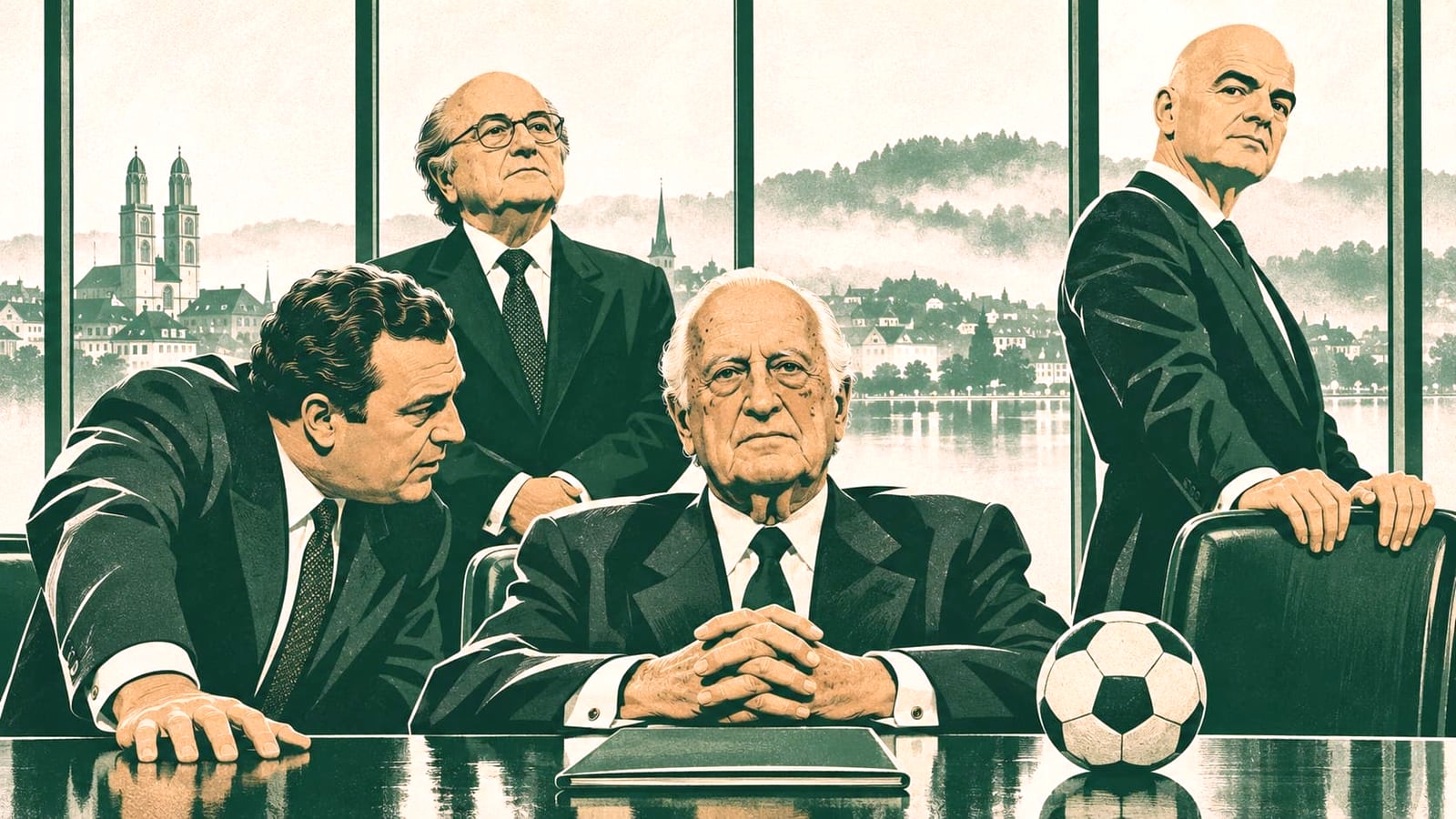
Cologne, October 2011. In a conference room dotted with journalists and anti-corruption campaigners, a man in a suit has spent more than an hour listening, stony-faced, to a list of his new employer's sins. Walter De Gregorio has been FIFA's communications director for only a few days, and he has had what is, in theory, a fairly clever idea: to go and take the temperature in "enemy" territory, at the Play the Game conference, the global headquarters of the people who document corruption in sport.
Then come the questions. Andrew Jennings gets to his feet. The Scottish journalist has been hounding FIFA for fifteen years, and he is not about to let this chance go: "How much is he paying you to save Blatter?" What follows is a masterpiece of crisis communication gone wrong. De Gregorio gets tangled up, tries a joke, and finally lands on his line of defence: a mafia, a cartel, they kill people, they carry guns… "we are talking about football". And then, as a last resort, a sentence that sounds like an admission of guilt: "I started on Monday."
History would give him four years in the job, and as long to rethink his definition of the mafia. On 8 June 2015, twelve days after the arrests at Baur au Lac, which he had been spinning to the world's press as best he could, De Gregorio was a guest on Roger Schawinski's talk show on Swiss television. At the end of the program, the host asked for his favourite FIFA joke. "The FIFA president, the secretary general and the communications director are in a car. Who's driving? The police." Three days later, FIFA announced his departure "with immediate effect". The man who had come to Cologne to swear his organisation was not a mafia left by the back door, dismissed by press release over a joke… about mafia. In Zurich, omertà is easier to forgive than a having a sense of humour.
The Gambino & FIFA families
Comparing FIFA to a criminal organisation should be the stuff of pamphlets, or at best a cynical response to what its own communications department has been promoting for decades with its obsession with the phrase "FIFA Family". The problem is that the metaphor exists in law.
FIFA belongs to a very short list of organisations designated as an "enterprise" under the RICO Act (Racketeer Influenced and Corrupt Organizations Act). In plain terms: not the defendant itself, but the structure through which the racket operates.
Passed by the US Congress in 1970 to bring down the bosses of the Cosa Nostra, by making it possible to convict the heads of a network without them having dirtied their own hands, the anti-mafia law was applied to world sport for the very first time on 27 May 2015. A historic first that football's global governing body could have done without.
Gianni's hot boy summer
Fast forward to summer 2026 and an American World Cup, where following FIFA's affairs was pure masochism for the average fan: a peace prize, a red card scandal, a summons to Congress and, as the grand finale, the biggest competition on the planet coming close to becoming a private asset between two handshakes at Trump Tower. A dizzying summer, and yet no anomaly. It was the logical outcome of a system, a method and a sense of impunity born on the Zürichberg hill half a century ago, and refined ever since.
We set out to untangle the thread of scandals to understand how football's world governing body got where it is today.
SEASON 1 — HAVELANGE, THE CRAFTSMAN
A bunch of chrysanthemums
Frankfurt, 11 June 1974, seven in the morning, the day of the FIFA presidential election. Sir Stanley Rous opens the curtains of his hotel room on a slate-grey sky pouring rain over the city. He does not yet know that this is his last day at the head of FIFA.
A former schoolmaster who refereed the 1934 FA Cup final, he just spent thirteen years presiding over an organisation that looks nothing like what it will become: fewer than a hundred members, a sixteen-team World Cup, a handful of staff in Zurich and a president who works from his living room in London.
Football is run there like a gentlemen's club, in the firm belief that the game belongs to the people who invented it. But that belief is about to crack wide open. Rous saw neither the globalisation of football coming (the African federations boycotted the 1966 World Cup), nor the money that was already knocking on the door up on the Zürichberg.
Standing against him is the Brazilian João Havelange, 58, the son of a Belgian engineer who made his fortune in the arms trade, a lawyer by training, the boss of Rio's buses, an Olympic swimmer in Berlin in 1936 (and a water polo player in 1952), and a politician to his fingertips. He does what no candidate for the job has ever done: he campaigns. He visits more than eighty countries, often with "O Rei" Pelé, and at every stop makes the same promise: stadiums, youth competitions and World Cup places for those who have none.
The result is decisive. For the first time since it was founded on the Rue Saint-Honoré in Paris, FIFA has a non-European president. Havelange embraces the loser and hands him a large bouquet. "For them, they were flowers," Rous would say. "For me, they were chrysanthemums" – in much of Europe, the flower of funerals.
Dassler, Blatter & Nally: the Machiavellis of Landersheim
The day after his victory, Havelange has a simple problem: he has promised development to half the planet, but has no means of paying for it. So he turns to the man who almost cost him the election. Horst Dassler, the boss of Adidas (and the son of Adi Dassler), had most of the European federations in his pocket and had lined almost all of them up behind Rous.
Impressed, Havelange decides to join forces with him and with his partner at the time, a London advertising man called Patrick Nally (see interview). Regarded as the spiritual father of sports marketing, Nally was one of the first to understand that sport could be a formidable tool for communication and advertising. With Havelange and Dassler, he signs the first global sponsorship deal in history in May 1976: the FIFA x Coca-Cola Football Development Programme, for around 10 million Swiss francs, a colossal sum at the time and enough to fund Havelange's expensive promises. To run the programme, Nally and Dassler place at FIFA someone close to them, whom they have trained in London, then in Landersheim: a certain Joseph Blatter, who would go on to become Havelange's general secretary.
Nally then discovers that FIFA does not even own the marketing rights to its own competition (i.e the World Cup). The advertising boards, the concessions, the licences: all of it belongs to the host country, which sells them to whoever it likes. The result is stadiums that look different from one match to the other, and nothing global to offer a global sponsor.
As it happens, the next host is Argentina, where a coup has just brought a junta to power. Sensing a chance to bring new money into FIFA, Nally goes to Buenos Aires to negotiate with the generals. He finds a regime with no idea of the goldmine it is sitting on. They have only one thing on their minds: their image. And Nally is about to sell them exactly what they need: a month of worldwide television in which Argentina looks like a "normal" country.
In return for that promise, he gets the marketing rights to the tournament. But his ingenuity doesn't stop there. He then sells those rights on, one sector at a time. Coca-Cola for soft drinks, Philips for electronics, Canon for photography… The buyer is no longer just paying to be seen; it also gets a guarantee that its competitor won't.
Two inventions come out of the negotiation, which the Englishman handles masterfully: category sponsorship, and the idea that sport can launder a reputation.
"You're too Anglo-Saxon"
At this point, we could (almost) close the file. A leader takes over a sleepy institution, finds the money that was missing, opens the game up to continents that had been ignored and, along the way, invents the economics of modern sport. That is a success story, not a scandal. Football in the 1970s needed money to stop being a closed gentlemen club, and sponsorship provided it.
Over twenty-four years, Havelange would bring in fifty new federations, create the youth, futsal and women's World Cups, and expand the World Cup from sixteen teams to thirty-two. That record is not a front. It is real, and it is the reason nobody, for a quarter of a century, wanted to look at what was really going on underneath.
One man is still talking about what was underneath. In the agreements he negotiates with Dassler, Nally finds a line he refuses to accept: payments meant not for FIFA, but for individuals. For Havelange in particular, who is not a FIFA employee and so has no reason to receive anything on the contracts he signs on the institution's behalf. But when Nally objects, Dassler replies that he "needs to keep control", and tells him he is "too Anglo-Saxon". Dassler's doctrine, summed up in a single sentence, would be the golden rule for years. From then on, every contract FIFA signs carries two prices: one for the service, and one for the signature.
Nally, for his part, is soon pushed out by Dassler. In 1982, when the Japanese marketing agency Dentsu offers Dassler the means to fund the next stage on his own, he chooses to do without his partner and sets up ISL, International Sport and Leisure, with Dentsu in Lucerne. The company inherits the contracts, the sponsors and the relationships Nally had brought in, and becomes the commercial middleman for FIFA, the IOC and world athletics. From now on, everything goes through ISL: the value, the access to the market, and the payments.
A bankruptcy that leaves a stain
The man who moved the money was Jean-Marie Weber, Dassler's right-hand man, whom the journalist Jens Weinreich would describe, when he died, as the greatest bagman in the history of sport. Shell companies, offshore accounts, cash: you name it! The payments made their way up to the decision-makers, yet nobody raised the alarm. Football kept growing, and so did ISL.
On May 21st 2001, ISL goes bankrupt. The trouble with a bankruptcy is that it turns arrangements between friends into accounting records. The auditors opened the books… and the Swiss authorities followed, opening a criminal investigation. In 2008, in Zug, the courts first dealt with the people who had carried the money: six former ISL executives were trialed, three of them ending up convicted, including Jean-Marie Weber, found guilty of diverting 90,000 Swiss francs into one of his personal accounts.
The beneficiaries were the subject of a second procedure, for "breach of trust, alternatively disloyal management". It targeted João Havelange and his former son-in-law Ricardo Teixeira, the head of Brazilian football and a member of FIFA's executive committee. The prosecutor's reasoning was simple: the commissions they had pocketed on the contracts were money owed to FIFA. In legal terms, they had enriched themselves at the expense of the institution they ran. FIFA was the victim; they were the perpetrators.
That case never reached a courtroom. Swiss law allows a case to be closed in exchange for compensation: the people under investigation pay the victim, and the proceedings stop without a verdict. In January 2010, the settlement was agreed at 5.5 million Swiss francs. Teixeira paid 2.5 million while denying any wrongdoing. Havelange paid 500,000 francs, without commenting on the accusations.
The third payer was FIFA itself. It put up the remaining 2.5 million, almost half of the compensation it was owed. In other words, the victim helped pay for its own damages so that its leaders would not have to explain themselves to a judge. And it attached a condition, spelled out in the order: its payment depended on the proceedings against its former president and its then-serving executive committee member being dropped.
141,967,500.93 francs...
Several newsrooms then spent two years fighting for access to the document. The case went all the way to the Federal Supreme Court, and in 2012 Switzerland's highest court ruled that it should be made public. FIFA put the document online the same day, with a press release welcoming the fact that it could at last be published. We found the full text of the judicial ruling, and this is what it says. Between 1989 and 2001, ISL paid 141,967,500.93 Swiss francs to decision-makers in world sport. Nearly 22 million of that went to accounts linked to the two Brazilians between 1992 and 2000. And the prosecutor writes, in black and white, that they "repeatedly used assets entrusted to them illegally for their own enrichment". These are the findings of an order closing the case, not the grounds for a conviction: nobody will ever stand trial over this money.
The file holds one last detail. A payment of one million meant for Havelange was transferred, by mistake, into a FIFA account. Who knew about it? The finance director, the prosecutor writes, "but also, among others, P1". P1 is a code. It stands for a FIFA official whose name the report withholds… but of whom the courts had not heard the last.
INTERVIEW — PATRICK NALLY: "I did exist, I still exist."
In 1976, this 29-year-old London advertising man signed the first global sponsorship deal in the history of sport with Coca-Cola, for João Havelange's FIFA and with the backing of Horst Dassler, the boss of Adidas. A few years later, he was pushed out of the system he had created, then erased from its official history. Fifty years on, he tells his side of the story. Interview recorded on 25 September 2026 for Dynasties, The Take's podcast. Edited for length and clarity.
The Financial Times called you the godfather of sports marketing. Do you agree?
It's a nice title. I would say false. Not the godfather, perhaps the creator.
Your book, Game Changer, is coming out. How does it feel to finally have it all on paper?
Well, it's taken me a long time to get round to writing the book, but I thought I must eventually put the true facts together of who actually did develop the sports marketing industry, as lots of other people have been given the credit and claims. And now I've got three children and grandchildren. I thought: last chance, let's get the game changer out there, just to put the record straight. Because obviously the record was hidden, certainly by FIFA and also the IOC and athletics. So it's a book about my own personal journey. It's not criticising, it's not trying to be anything other than my personal journey: how I got involved and helped create this global sports marketing business.
You left school at fifteen. How did you end up founding West Nally?
At fifteen, when I left school, I became a messenger boy at an advertising agency in London, and obviously did what messenger boys do: moved around London, got to know London well, got to know the way an agency worked. I ended up in the public relations department because my mother was in public relations, and the people that headed up that division knew her and recruited me. One of the things that had the biggest impact on me was working for what was then the British football pools, Littlewoods Pools, which introduced me to sports journalists. I had to regularly go to Fleet Street and meet the old hacks. I ended up, obviously, learning how to drink with them. And of course that showed me the passion of football. I studied the teams and the results, because depending on those results, I would probably be going off to talk to somebody who had won a substantial sum of money. I brought those people into London, organised the presentation of cheques, got them to allow publicity, and got to understand how the media worked.
Then I was offered the job of heading the PR division of a new agency, working with a figurehead, a man called Peter West. Peter was a sports broadcaster on the BBC. I remember getting to know him, and I came up with something I thought was a smart thing to say. I said: "Peter, you seem to know a lot about sport. Why don't we make sport a means of communication?" I hadn't really thought it through. It was a smart-arse remark to impress him. It impressed him. Our very first client was Green Shield, a trading stamp company, and I came up with a plan to teach young kids how to play tennis, a grassroots programme across the whole country. It was probably the first well-thought-through, sport-related response to a big communication requirement. Quite quickly, I decided I'd like to go out on my own. And Peter said: "No, no, you're not going out on your own, I'm coming with you." So that was the birth of West Nally. And West Nally really started, I think, in 1970.
How did you meet Horst Dassler, and what kind of man was he?
I got a call from an ex-British athlete called John Boulter, who said: "Horst Dassler would like to meet you." And I remember saying to John: "Who is Horst Dassler?" I had no idea who he was. So in late '74, I was invited over to meet Mr Dassler in Landersheim, at his auberge. Tremendous food, wine, and long nights of talking. I found him an extraordinary person, obviously multilingual. I think the first time we met we sat up till probably four or five in the morning, just talking, talking, talking.
What I heard, because I met him after all this had happened, was that Horst, at the last minute, realising that Havelange had done a tremendous job travelling around the world, and that Sir Stanley was likely to lose, mounted a campaign to support Sir Stanley and almost turned it over. Not completely, because obviously Havelange did win, but it was a much closer challenge than Havelange ever thought, which made him realise that Horst had a lot of influence. So rather than it being a negative, it became a positive. And that of course then put Horst under pressure. How was Havelange going to fund his eight-point plan? Because FIFA had no money, Havelange didn't have the resources, and Horst had no money. Which is why, I think, John Boulter invited me over to meet Horst: they were hoping I could introduce the money.
And the money was Coca-Cola.
I knew the Coca-Cola Company. Up until then, there were no global marketing budgets: all of Coca-Cola's activities were local decisions. But their very senior head of marketing was interested in the evolution of global budgets, and sport is a global subject. They also wanted to improve local acceptance of the Coca-Cola Company, to show it wasn't just something that had been introduced by the military, because obviously Coca-Cola went into many countries through the US military. I travelled the world talking to people, getting information, discussing, even down to who was going to manage it, which is why we then had to find Mr Blatter, because we needed somebody inside the house to manage it. I have a feeling it took me about sixteen months to put all that together, present it to the Coca-Cola Company, and get Coca-Cola to agree and sign on the dotted line.
Is it true that you trained Sepp Blatter for months at Adidas in Landersheim before placing him at FIFA?
Almost true. He spent his first time with me and my team in London, having recruited him, and then he spent time with Horst and his team in Landersheim.
Do you still get a Christmas card from Sepp every year?
Not necessarily a Christmas card, but we do share a WhatsApp message from time to time.
How do you price something that has never been priced before?
Put my finger up. Nobody else was volunteering, so Muggins here sort of decided what I thought was a reasonable amount, only to find out later that it was going to become a very unreasonable amount. But that's all part of the story. FIFA had no money, so I had to go back to my client, Coca-Cola. I pitched to the Coca-Cola board in Atlanta and got their agreement to provide a guarantee of, I think, around ten million Swiss francs.
How did you end up negotiating with the generals in Argentina?
It was terrifying. FIFA were not very well structured: very few staff in rented offices in Zurich, very modest. And I didn't want Pepsi-Cola, because the cola wars were pretty much raging back then, to be able to get access. It was recommended that somebody needed to go and meet the new military junta. I was nominated. Nobody else wanted to go. I asked whether I would have the ability to threaten to move the event if there wasn't going to be collaboration, and Havelange and Käser told me I could use that threat if necessary. I got on a plane to Buenos Aires. I got off the plane, surrounded by military cars and guns, and was taken to the Sheraton Hotel where we were going to be meeting. No sooner had I got out of the car than I was bundled back into it, sent back to the airport and put on a Braniff flight to Miami. Not that I wanted to go to Miami. General Actis, one of the generals of that time who was going to be heading the World Cup, was blown up in his bed that morning. I had no idea about it, but you can imagine I wasn't very happy. I was very scared. Then we got a message saying they would like me to go back. Nobody volunteered again. So I went back, and to my surprise I found the generals, and specifically Viola, very collaborative. They knew a lot about me. They knew about my public relations background. They knew the World Cup was an important public relations exercise for them. They were, to my shock and surprise, extremely collaborative: yes, we need to do everything to create the right image for this event. The only condition we need is that we must win.
In the stands, the generals are wearing double-breasted suits, not military uniforms. Was that part of your discussions with them?
Yeah. A little while before the World Cup, I attended a Formula One-type event there with Coca-Cola. There was a lot of barbed wire, a lot of military and guns in sight. And I said to them: "This couldn't happen at the World Cup. There can't be any military attendance, there can't be any guns. Let's put all of the security into Adidas three-stripe kit", which obviously Horst was ecstatic about. So yeah, the PR man in me, and the PR acceptance on the other side: they fully accepted that if this was going to give the image we needed globally, there would be no military uniforms, no military in the stadia. Only athletes, or what looked like athletes, but they really were military. They adhered entirely to the public relations training that my mum had given me, and they did it brilliantly. I won't tell you about Peru and making sure they won the match with Peru, but there we go. Best kept to oneself.
[Editor's note: on 21 June 1978, Argentina needed to beat Peru by at least four goals to reach the final. They won 6-0. The match has been the subject of suspicion of fixing for almost fifty years, but nothing has ever been proven.]
Once we got the full rights to the World Cup, it was total rights: clean stadia, control of the advertising, control of the licensing, both the Gauchito mascot and the logo. For the first time ever, a world exclusivity of control of all of the rights. Coca-Cola had dominant signage, pouring rights in the stadium, world exclusivity in the soft drinks category. Then I put together exclusive packages with Seiko, Canon, Philips. So it was the first time any world event had centralised rights, centralised control. And in 1978 it cost the Coca-Cola Company zero. I can't tell you just how excited and happy everybody was at the end of the final when Argentina won. I've never seen a country's population go from rock bottom to rock high over such a short period of time. It was an extraordinary experience that I'll never forget.
What happened next?
What happened in '78 was my own success, I think, bouncing back on me. I was perhaps too successful. Havelange wanted to go from the sixteen teams we had in Argentina to twenty-four teams in Spain, but Spain had already committed to sixteen, so there had to be a negotiation. Later in 1978, in Madrid, Horst had a sort of private discussion I was unaware of, and he met me in the gents' toilet before the other discussions were going to continue and told me that I had to find 45 million. How he got to 45, I'm sure he just went like that as well. Stupidly, as a young man always wanting to say yes, yes, yes, and looking at Horst as a father figure, I said: "OK, let me think about it." Forty-five million was probably too much for a single event lasting a few weeks. We needed a programme. So I created what we called InterSoccer 4: the Gold Cup in Uruguay, the European Championship in Italy in 1980, the other UEFA events, the World Youth Championship… In the end, I had to raise something like 130 million. Which is what I did. It wasn't easy. It was unbelievable stress, but we did it. And it worked extraordinarily well. It's the benchmark for the Olympic TOP programme, for athletics and for all the other programmes. But again, perhaps I was too successful.
Is it true that your business was taken from you in a single week?
It was taken, true. In his very clever way, Horst said to me: "Patrick, I've been offered all this money by Dentsu. I don't have to give Dentsu any equity or shares, because I have it all. Appreciating that you raised the money I needed, and that we did agree that's what we were going to do, if you were in my position, what would you do?" And I thought, yeah, probably. It's a pretty no-brainer from where he sat. Not nice from where I sat.
Why did you never take it to court?
Exhaustion. Youth: I was still quite young, and I had no idea what I'd really created. And Horst, as he said to me: "I now have deep pockets." It would have been a very tough uphill battle. My lawyers at the time indicated it would take a hell of a lot of investment. And I was still probably thinking he was going to make things good, maybe stupidly. It took me quite a while to give up on that belief. Even when I met Juan Antonio Samaranch at Henley a few years later, he sort of indicated that maybe things would be re-established or improved. But that was all negated once Horst passed away in '87. The control then sat with ISL, and they did everything in their power to block me. You cannot believe it. It was like we were at war, and I never knew why we were at war. They just didn't want people to know that I had existed, and that the programmes weren't created by them.
You have also said that Dassler told you that you were "too Anglo-Saxon".
Absolutely correct. When I was asked by Horst to raise the money to buy him out, which was called Project West, and I raised the money, we had a big argument, because he put into the figures payments to Havelange. And I made it very clear: no, we shouldn't be paying Havelange. FIFA should be paying Havelange. Blatter was going to be paid by FIFA. So if Blatter was being paid by FIFA, then Havelange, if he was a professional president, should be paid by FIFA. Horst said absolutely no: "I need to keep control."
I don't think deep down Havelange was a bad, evil person. I think he was absolutely incredible in what he did to build FIFA. He was a visionary, and maybe later became a bandit. He did wrong to accept Horst's payments rather than taking a salary, because he was a full-time president and it could have resolved all of it. From Horst's point of view, controlling the federations gave him power. Whether it was the IOC, athletics, FIFA or boxing, he always saw the man in the presidential role as the person to have control and influence over. So with this newfound money, let's put the power at the centre. Money protects the centre, the centre protects the money. And it hasn't changed. In all these years, that one issue I used to have a big argument about, and got called too Anglo-Saxon for, is the heart of the issue.
Is it true you've known Gianni Infantino since he still had hair?
True. Infantino was at CIES long before he even went to UEFA, and I've been a great advocate of the FIFA Master; education in our industry is something amazing to me. But it's not the individual, it's the system. Everybody agreed, agreed, agreed for Havelange to be re-elected. Then Blatter: re-elected, re-elected, re-elected. Then it came to Infantino, and it's the same. Power corrupts, and the power has got to be taken away from this little cadre of individuals, because that is not in the interest of the sport, and it's not in the interest of the fans. The good thing about UEFA, which is what I like, is that they're using the legal system for disclosure. It's not so much whether they will or won't win in court. It's that there has to be full disclosure. If they do a good job, what has to happen in March is not just a change of president, but a change of structure, because whoever is selected shouldn't have that magnitude of power. Going back to my early days with those hacks in Fleet Street, knowing the passion of the mothers, the daughters, the sons who follow the traditions of their teams: whose sport is it? It's there for the fans, not for a little group of people manipulating it because they've got central control of the money.
Knowing everything you know now, would you sign the 1976 deal again?
I wouldn't have changed anything. What I should have done differently was not trust. I didn't have a close father relationship in my own history: my father left when I was around ten. So Horst became a bit of a father figure, but I trusted him too much. I should have fought him harder. But it was craziness. During that World Cup, I was going to Moscow and dealing with the KGB, I was creating world championships in athletics. It was a crazy, crazy life. I'm proud of what we did, and there were about a hundred key people involved in West Nally. It wasn't just me.
And that's the reason the book is there. Let's just remember that these presidents, Nebiolo, Havelange, Samaranch, were instructed by Horst to pretend I didn't exist. Well, enough is enough. I did exist, I still exist. Why the hell can't I even be invited to an event? You'd think I'd at least be invited to a World Cup event, or an Olympic event. Still today I don't get a single credit, a single invitation. I've not had one single award. So yeah, come on, guys. Enough is enough.
Game Changer by Patrick Nally was published on 8 October 2026.